
The Russian president made the remarks as world leaders gather in New Delhi for the 18th BRICS Summit following a day of bilateral talks and a major business forum
Published 12 Sep, 2026 08:11
| Updated 12 Sep, 2026 11:36
BRICS is “not against anyone” but focused on the development and prosperity of its members, Russian President Vladimir Putin said, as world leaders gathered in New Delhi for the grouping’s 18th summit.
Putin made the remarks at the BRICS Business Forum on Friday, part of a packed program of bilateral talks and discussions on trade, investment, energy, and global challenges, before the leaders’ meeting formally opened on Saturday.
“BRICS’ work is not directed against anyone,” Putin said. “It is aimed at only one common goal: the sustainable development and prosperity of our countries and peoples.”
Putin said the group seeks to unlock its members’ potential through “business diplomacy,” making it easier for companies and entrepreneurs to cooperate and invest.

He contrasted this with what he called the West’s “ugly forms” of competition, including unilateral “illegal restrictions” and secondary sanctions against countries “unwilling to follow others’ interests.”
Despite the tensions, Putin stressed that Moscow does not intend to retreat behind political blocs: “We are open to working with the whole world.”
Friday saw Putin hold a flurry of meetings with New Development Bank President Dilma Rousseff, Malaysian Prime Minister Anwar Ibrahim, Egyptian President Abdel Fattah el-Sisi, and South African President Cyril Ramaphosa.

He also held talks with Indian Prime Minister Narendra Modi and discussed cooperation in trade, energy, defense, space, and other sectors.
Friday’s whirlwind of diplomacy and Indian pageantry set the stage for two days of leaders’ talks. What began as a four-country forum has grown into an 11-member economic heavyweight with increasing global clout as geopolitical tensions mount and the Western-led international order comes under growing pressure.
RT reporters are on the ground in New Delhi covering the 18th BRICS Summit, which runs through Sunday.
Show latestShow oldest
-
12 September 2026
11:41 GMT
The BRICS Summit has demonstrated the bloc’s potential to deepen cooperation and help reshape global governance, Putin said.
“The summit confirms that we have great potential to work together, to expand mutually beneficial cooperation, to make global governance more effective, and to ensure true multilateral cooperation and equity in global affairs,” he told fellow leaders in New Delhi.
- 11:38 GMT
Putin said reforming the IMF, World Bank, and WTO will not be enough to keep pace with the changing global economy.
He noted that emerging fields such as fintech, digital commerce, and the platform economy require new mechanisms.
“There are breakthrough areas… which require separate institutions, rules, and regulations,” he said, adding that BRICS countries have already begun work in this direction.
- 10:43 GMT
Global financial institutions must be overhauled to reflect the shift in economic activity toward emerging markets, Putin said.
READ MORE:
20 years of BRICS: From Wall Street acronym to global power centerHe noted that the IMF, World Bank, and World Trade Organization were created under “different political and economic realities” and are struggling to adapt to a rapidly changing world. Nevertheless, he called for stronger BRICS cooperation with them as important platforms for “dialogue between the leading economies of the world.”
- 10:43 GMT
The unipolar system of international relations is fading as global influence shifts toward new centers of growth, Putin stated.
He accused countries with a “colonial mindset” of resisting the shift through sanctions, tariff wars, “blackmail,” interference in domestic affairs and “blunt force.”
He called for strengthening the UN’s central role, arguing that its charter remains the “key source of international law” despite attempts by some states to replace it with a “rules-based world order.”
“No one knows what these rules are,” Putin said, also backing an expansion of the UN Security Council to include greater representation for African, Latin American and Asian nations.
- 10:43 GMT
BRICS is emerging as a key center of global governance because it is built on equality and respect for its members, Russian President Vladimir Putin has told the summit in New Delhi.
“We are based on respect for the traditions, values and history of each other. That’s why our authority is growing,” Putin said, highlighting the bloc’s “huge intellectual and technological potential.”
“It is on our joint actions and decisions that global politics and security, the global economy and humanitarian cooperation depend,” he added.
- 10:37 GMT
BRICS has an opportunity to use its growing economic and political clout to help resolve global crises where Western-led approaches have failed, South African researcher Mikatekiso Kubayi has told RT.
“The world is watching,” he said, pointing to the Ukraine conflict and tensions in West Asia. Kubayi said closer coordination between BRICS members would allow the bloc to “flex its potential” on the global stage.
- 10:36 GMT
BRICS should use its collective weight to push back against US and Israeli actions in the Strait of Hormuz, Indian academic Anuradha Chenoy told RT.
“Who stopped the freedom of navigation in the Straits of Hormuz? The Americans and the Israelis,” she said, arguing that disruption of the key energy route has particularly hurt India and China. Chenoy said Russia has provided both countries with an important alternative source of energy.
The Strait of Hormuz is a key route for global oil and gas supplies and has become a major flashpoint in the US-Israeli war against Iran. Tehran has accused Washington and West Jerusalem of threatening commercial shipping and destabilizing energy flows through the region.
- 10:26 GMT
Russia’s relations with Europe have been reduced “nearly to zero,” creating greater instability and confrontation on the continent, Kremlin spokesman Dmitry Peskov told RT on the sidelines of the BRICS Summit.

“The world is bigger than Europe. The world is bigger than the United States,” Peskov said, arguing that the future lies in a diverse, multipolar system rather than a unipolar world.
He described BRICS as a grouping united by a shared vision that “is not aimed against the US or European countries,” but at the prosperity of its members, echoing similar remarks made by Putin on Friday.
Peskov also accused Washington of weaponizing the dollar, but argued that this has ultimately benefited Russia, as it was pushed to use other currencies, which now account for more than 90% of its trade with BRICS countries.
“Once we did that, we understood that the system is much more effective,” he said. “But was it originated by BRICS countries against the US dollar? No. It’s because it was a mistake done by the US.”
- 10:26 GMT
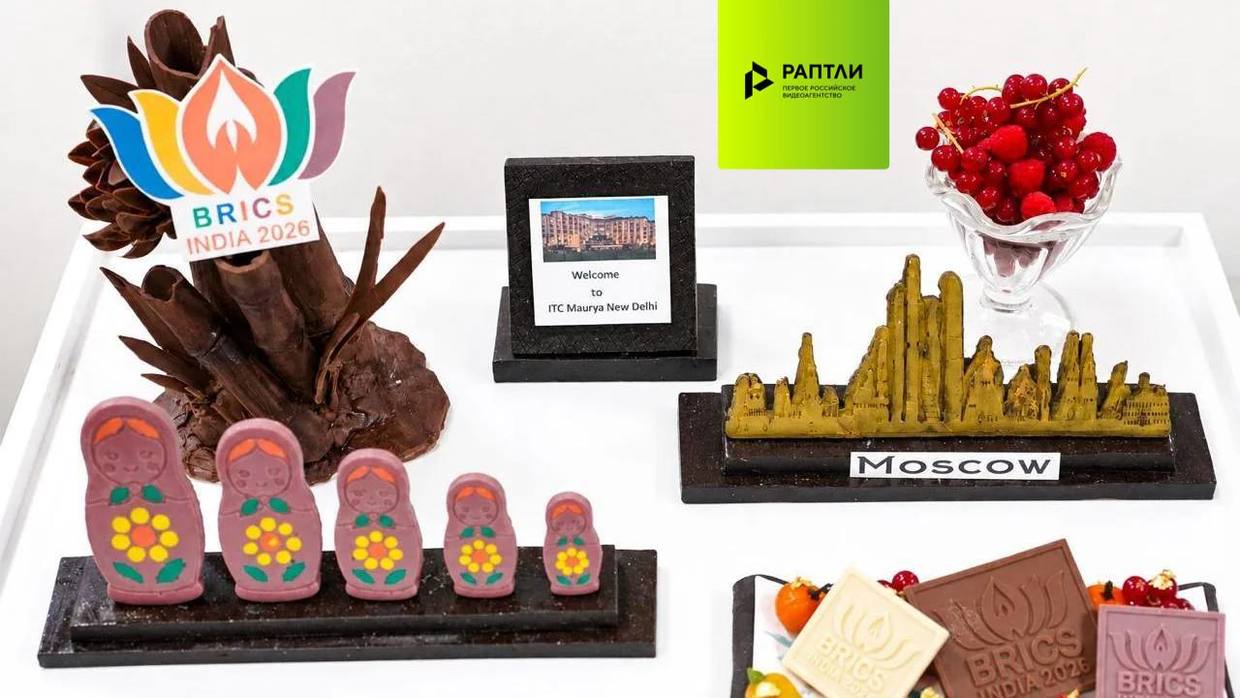
Russian guests at the New Delhi hotel where Putin is staying received an Indian-style welcome – complete with chocolates shaped like the Moscow skyline and matryoshka dolls.
The gifts were prepared for members of the Russian delegation as leaders and officials continue meetings on the sidelines of the summit.
© Ruptly
- 10:26 GMT
Modi has shared a warm snapshot from the BRICS Summit showing himself alongside Vladimir Putin and Xi Jinping – all three smiling broadly as they chat.
Posted to Modi’s Instagram, the candid shot has the three leaders looking more like old friends catching up than heads of major powers navigating a packed diplomatic agenda.
Sometimes summit chemistry needs no communique.
View this post on Instagram
More
-
12 September 2026
06:17 GMT

As BRICS leaders gather in New Delhi, India is seeking to position itself as a diplomatic bridge in an increasingly polarized world. New Delhi has maintained ties with opposing sides in major conflicts, resisted Western pressure over Russian oil, and repeatedly called for dialogue rather than military solutions.
RT looks at how India’s ‘diplomacy-first’ approach has shaped its response to the conflicts in Ukraine and the Middle East – and what it could mean for the BRICS Summit.
- 06:32 GMT
BRICS can withstand external pressure and continue to expand because it offers countries of the Global South an alternative platform based on mutual respect rather than Western dominance, Indian MP Sujeet Kumar told RT.
Speaking on the sidelines of the BRICS Summit in New Delhi, the BJP lawmaker stressed that the group is “non-West, but it is not anti-West,” arguing that Washington’s perception of BRICS as anti-American is “its problem, not the problem of BRICS.”
Kumar said the group seeks greater representation for developing nations in global institutions, arguing that the existing governance architecture no longer reflects the economic and demographic realities. He cited growing BRICS membership and interest from other countries as evidence of demand for greater economic resilience, diversified supply chains, and a stronger voice for the Global South.
- 06:34 GMT

Relations between China and India have steadily improved since a breakthrough meeting between President Xi Jinping and Prime Minister Narendra Modi at the BRICS Summit in Kazan in 2024.
High-level contacts have resumed, progress has been made on managing their disputed border, direct flights have returned, and bilateral trade has reached record levels.
As the two leaders prepare to meet again at the BRICS Summit in New Delhi, RT’s Marina Kosareva looks at how relations between the Asian powers have evolved.
- 07:04 GMT
Chinese President Xi Jinping has arrived in India for the BRICS Summit. His two-day visit is expected to include talks with Indian Prime Minister Narendra Modi.
No formal meeting between Xi and Russian President Vladimir Putin is scheduled, although the two leaders could hold an informal conversation on the sidelines.
- 07:11 GMT

This year’s gathering has particular significance – 20 years ago, in September 2006, the foreign ministers of Brazil, Russia, India, and China met for the first time on the sidelines of the UN General Assembly in New York. Known at the time as ‘BRIC’, the fledgling group was widely seen as a political experiment with an uncertain future.
Two decades later, it has expanded into an economic heavyweight with growing global influence. RT looks at how BRICS went from a four-country forum to a major force challenging the old global order.
- 07:20 GMT

Western efforts to isolate Russia have instead accelerated the shift of economic power toward BRICS and undermined the dollar’s global position, American journalist Tucker Carlson says.
Carlson told Afshin Rattansi’s Going Underground that cutting off Russia from the SWIFT financial system after the escalation of the Ukraine conflict gave other countries a powerful incentive to reduce reliance on the dollar.
“If we’re using the US dollar as a weapon of war, there’s no greater incentive for countries to de-dollarize,” he said. “That’s crazy. It’s self-destructive behavior.”
Carlson also argued that US, British, and German policies ultimately weakened the countries pursuing them. “This is self-harm we’re watching,” he said, adding that the effect has been “to dethrone the West” and “topple the American empire.”
- 07:42 GMT
Iranian President Masoud Pezeshkian has held separate meetings with Ethiopian Prime Minister Abiy Ahmed Ali and Malaysian Prime Minister Anwar Ibrahim on the sidelines of the BRICS Summit in New Delhi.
Pezeshkian arrived in New Delhi on Friday and met with the host, Prime Minister Narendra Modi, hours later, ahead of Saturday’s main summit program.
- 07:52 GMT
Modi has met with Ethiopia’s Abiy on the sidelines of the summit as well, hailing his first visit to India as taking an “old friendship into new frontiers.”
In a post on X, Modi said the talks covered defense, investment, critical minerals, clean energy, healthcare, and capacity building, with the two sides pledging to work on strengthening India-Africa ties and “amplify the voice of the Global South.”
India and Ethiopia are taking an old friendship into new frontiers!
Delighted to welcome PM Dr. Abiy Ahmed Ali on his first visit to India.
Today’s talks covered:
Defence.
Capacity building.
Investment linkages.
Critical minerals.
Clean energy.
Healthcare.… pic.twitter.com/V7i1hqAqIu
— Narendra Modi (@narendramodi) September 12, 2026
- 07:53 GMT
Modi also welcomed Abu Dhabi Crown Prince Khaled bin Mohamed bin Zayed Al Nahyan for talks on the sidelines of the gathering.
The two discussed strengthening the India-UAE strategic partnership, including cooperation in trade, investment, technology, energy, and defense, as well as regional and global developments.
Khaled is leading the UAE delegation at the summit on behalf of President Sheikh Mohamed bin Zayed Al Nahyan. The UAE joined BRICS as a full member in 2024.
- 08:18 GMT
READ MORE:
BRICS seeks cheaper payment mechanisms to side-step US dollarBRICS members agree on strengthening national currencies and expanding their use in mutual trade, but remain divided over a single currency, Iranian Foreign Minister Abbas Araghchi said on the sidelines of the summit in New Delhi.
“There are different opinions” within BRICS, Araghchi told reporters. “All members of the group believe that national currencies should be strengthened and trade between member states should be conducted in national currencies.”
A common BRICS currency, however, “is still under consideration,” he added.
Araghchi: BRICS Is Moving Away From The Dollar, But Not To One Currency… Yet
Iran's foreign minister says BRICS members agree on strengthening national currencies for trade, while a single currency is "still under consideration."
📹 ANI pic.twitter.com/FAOh9O4iN3
— RT_India (@RT_India_news) September 12, 2026
More