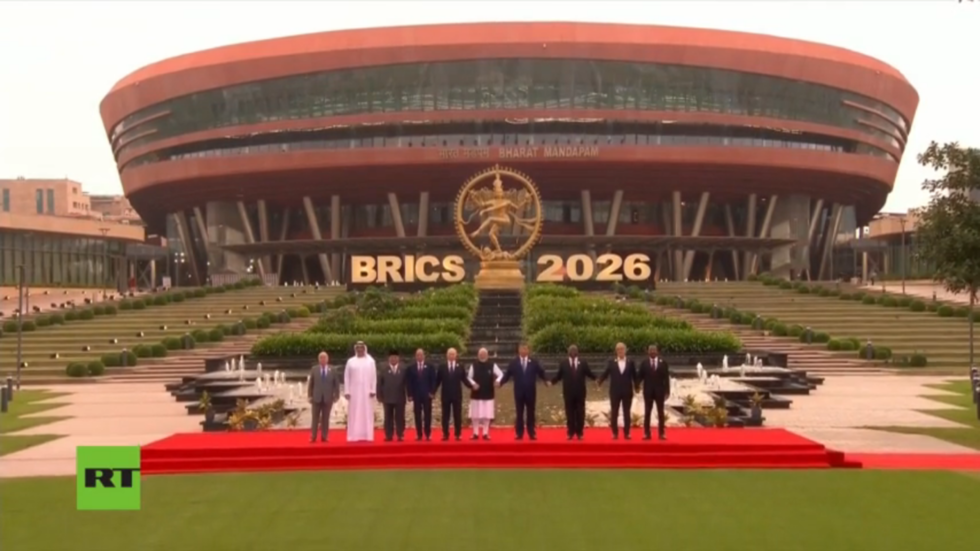
The Indian prime minister made the remarks as BRICS leaders adopted the New Delhi Declaration at the group’s 18th annual summit
Published 12 Sep, 2026 08:11
| Updated 12 Sep, 2026 14:27© RT/Instagram/Modi
The changing world “cannot be steered by outdated institutions,” Indian Prime Minister Narendra Modi said on Saturday as BRICS leaders adopted the New Delhi Declaration at the annual summit in New Delhi.
The two-day gathering, which runs September 12-13, has brought together leaders from BRICS member and partner countries, with bilateral meetings also taking place on the sidelines.
“Reforms are essential in representation, responsiveness and rule-making,” Modi said, calling for a greater role for the Global South in international decision-making.

The declaration backs reform of the UN and global financial institutions to give developing countries greater representation, and condemns unilateral sanctions that violate international law.
Earlier on Saturday, Russian President Vladimir Putin described BRICS as an emerging center of global governance, saying global politics, security and the economy increasingly depend on the group’s joint decisions.
RT reporters are on the ground in New Delhi covering the 18th BRICS Summit, which runs through Sunday.
Follow the latest developments from New Delhi below.
Show latestShow oldest
-
12 September 2026
16:28 GMT
Narendra Modi and Xi Jinping met on the sidelines of the summit for face-to-face talks, with the two leaders discussing the “full range” of relations between China and India. The Indian side has conveyed its “best wishes” for the upcoming rotating BRICS Presidency, which Beijing is set to hold next year, Modi wrote on X.
- 16:10 GMT
BRICS is not, by any means, an anti-Western group, and it is designed as a “platform for mutually beneficial partnership where member countries of BRICS can come together,” Indian MP Sujeet Kumar has told RT.
“My prime minister has very, very categorically said many times that BRICS is non-Western, but it is not anti-Western. And if the US, and particularly President [Donald] Trump, perceives it to be anti-American or anti-US, I think it’ s his problem, not the problem of BRICS,” Kumar stated. “BRICS is a platform for the growth, development, prosperity of the Global South,” the lawmaker stressed.
- 15:03 GMT
The BRICS Gala Dinner is underway at the Bharat Mandapam exhibition hall in New Delhi, concluding the first day of the summit, with BRICS leaders in attendance. RT footage shows Russian President Vladimir Putin arriving.
- 14:36 GMT
BRICS should take a stronger posture in helping member states resolve disputes, the head of the BRICS Research Institute, Fulufhelo Netswera, told RT.
“I think it would be good that BRICS take a very strong posture and sit down [with] the nations, the BRICS nations, where there are tensions, and be able to proactively resolve those tensions,” he said.
Netswera added that the disruption in the Strait of Hormuz greatly affects the group, especially African nations which “are highly dependent on energy importation, but they are equally also dependent on the importation of grain and fertilizers.”
“The challenge is immense, and we need to transform ourselves to be able to absorb these shocks, these disruptions better into the future.”
- 14:26 GMT
The Kremlin’s investment envoy, Kirill Dmitriev, has shared on social media a photo of Russian President Vladimir Putin, Indian Prime Minister Narendra Modi, and Chinese President Xi Jinping. “The Leaders are only missing their friend, President Trump, to complete the circle,” he captioned the image.
Speaking on the sidelines of the summit to Russian media, Dmitriev said preparations for the proposed Russia-US-Germany business forum have gained traction, with two locations currently being considered and a final decision on the venue expected by the end of the year.
“We have two proposals regarding where to hold this forum. One country is in the Middle East, and the other is a country closer to the Middle East,” he said, adding that a “truly neutral” country will likely be picked.
The Leaders are only missing their friend, President Trump, to complete the circle. 🕊️ pic.twitter.com/KgLEAclt96
— Kirill Dmitriev (@kadmitriev) September 12, 2026
- 13:46 GMT
The Russian president met with Sheikh Khaled bin Mohamed bin Zayed Al Nahyan, Crown Prince of Abu Dhabi, on the sidelines of the summit, discussing the situation in the Middle East and beyond.
“The region is going through difficult times, and we maintain constant contact. These difficult times will pass and our relations will continue to grow stronger,” Putin said at the meeting.
The UAE remains “one of the closest nations” for Russia in the region, Putin said. The two countries continue to bolster cooperation in various areas, including security and politics, as well as enjoying steadily growing trade, he added.
- 13:41 GMT
The Russian delegation met with their Ethiopian counterparts led by Prime Minister Abiy Ahmed Ali. During the meeting, the Russian president praised Ethiopia as “a long-standing and reliable partner,” adding that ties between the two nations “continue to develop based on the principles of equality and mutual benefit.”
“Bilateral trade has built a solid momentum. Trade turnover has more than tripled and continues to grow. This is a positive indicator,” Putin said, adding that he is looking forward to hosting the prime minister at the upcoming Russia-Africa summit in Moscow.
- 12:35 GMT
The New Delhi Declaration provides a “clear direction” for the group and must now be translated into concrete results, Modi said in his closing remarks at the summit.
“Alongside the diversity of our views, our shared commitment to BRICS cooperation has also clearly emerged,” Modi said, arguing that the discussions showed a changing world “cannot be steered by outdated institutions.”
He called for reforms in global representation, responsiveness and rule-making, as well as equal participation for the Global South in developing future technologies and the rules governing them.
⚡️BRICS Nations Formally Adopt Declaration Following Summit Meeting
It outlines clear directions for the development of the bloc, PM Modi said.#BRICS2026#BRICSIndia2026#IndiaBRICSChairshiphttps://t.co/iRD6WbkUSxpic.twitter.com/5Jh54nUFy7
— RT_India (@RT_India_news) September 12, 2026
- 12:26 GMT
BRICS leaders have adopted the New Delhi Declaration, setting out the expanded bloc’s common position on global governance, trade, finance and major international conflicts.
The document calls for a “more representative, fairer international order” and greater Global South influence in global decision-making, including comprehensive UN reform and greater developing-country representation on the Security Council. China and Russia also reiterated support for Brazil and India playing a greater role at the UN.
Swagatam BRICS leaders for the 2026 Summit. pic.twitter.com/SkmO9rV2Kf
— Narendra Modi (@narendramodi) September 12, 2026
On the economic front, BRICS voiced “serious concerns” over tariffs and other trade restrictions and condemned unilateral and secondary sanctions not authorized by the UNSC. Members also backed further work on faster, cheaper cross-border payments and greater use of national currencies in trade and investment.
On global conflicts, the declaration emphasizes diplomacy and peaceful settlement of disputes, backs a Palestinian state within the 1967 borders with East Jerusalem as its capital, opposes the forced displacement of Palestinians and condemns attacks on civilians and obstruction of humanitarian aid in Gaza.
The bloc also backed an expanded role for the New Development Bank, including more local-currency financing, while pledging deeper cooperation on AI, digital infrastructure, trade and investment.
⚡️India Commended For Injecting 'New Impetus To Strengthen International Cooperation & Solidarity' In BRICS Declaration#BRICS2026#BRICSIndia2026#IndiaBRICSChairshiphttps://t.co/FiRMJQlrkspic.twitter.com/2kDP69WcFZ
— RT_India (@RT_India_news) September 12, 2026
- 12:23 GMT


Modi has spent half a minute straight shaking hands with Xi Jinping while thanking him for attending the BRICS Summit in New Delhi in person, offering a notably warm welcome to the Chinese leader.
The gesture comes against the backdrop of a historically difficult relationship between the two Asian neighbors, marked by a long-running border dispute and years of tensions following deadly clashes in 2020.
India and China have moved to stabilize ties in recent years, with Modi and Xi holding a series of meetings and both sides seeking to rebuild political and economic engagement.
More
-
12 September 2026
06:17 GMT

As BRICS leaders gather in New Delhi, India is seeking to position itself as a diplomatic bridge in an increasingly polarized world. New Delhi has maintained ties with opposing sides in major conflicts, resisted Western pressure over Russian oil, and repeatedly called for dialogue rather than military solutions.
RT looks at how India’s ‘diplomacy-first’ approach has shaped its response to the conflicts in Ukraine and the Middle East – and what it could mean for the BRICS Summit.
- 06:32 GMT
BRICS can withstand external pressure and continue to expand because it offers countries of the Global South an alternative platform based on mutual respect rather than Western dominance, Indian MP Sujeet Kumar told RT.
Speaking on the sidelines of the BRICS Summit in New Delhi, the BJP lawmaker stressed that the group is “non-West, but it is not anti-West,” arguing that Washington’s perception of BRICS as anti-American is “its problem, not the problem of BRICS.”
Kumar said the group seeks greater representation for developing nations in global institutions, arguing that the existing governance architecture no longer reflects the economic and demographic realities. He cited growing BRICS membership and interest from other countries as evidence of demand for greater economic resilience, diversified supply chains, and a stronger voice for the Global South.
- 06:34 GMT
Relations between China and India have steadily improved since a breakthrough meeting between President Xi Jinping and Prime Minister Narendra Modi at the BRICS Summit in Kazan in 2024.
High-level contacts have resumed, progress has been made on managing their disputed border, direct flights have returned, and bilateral trade has reached record levels.
As the two leaders prepare to meet again at the BRICS Summit in New Delhi, RT’s Marina Kosareva looks at how relations between the Asian powers have evolved.
- 07:04 GMT
Chinese President Xi Jinping has arrived in India for the BRICS Summit. His two-day visit is expected to include talks with Indian Prime Minister Narendra Modi.
No formal meeting between Xi and Russian President Vladimir Putin is scheduled, although the two leaders could hold an informal conversation on the sidelines.
- 07:11 GMT

This year’s gathering has particular significance – 20 years ago, in September 2006, the foreign ministers of Brazil, Russia, India, and China met for the first time on the sidelines of the UN General Assembly in New York. Known at the time as ‘BRIC’, the fledgling group was widely seen as a political experiment with an uncertain future.
Two decades later, it has expanded into an economic heavyweight with growing global influence. RT looks at how BRICS went from a four-country forum to a major force challenging the old global order.
- 07:20 GMT

Western efforts to isolate Russia have instead accelerated the shift of economic power toward BRICS and undermined the dollar’s global position, American journalist Tucker Carlson says.
Carlson told Afshin Rattansi’s Going Underground that cutting off Russia from the SWIFT financial system after the escalation of the Ukraine conflict gave other countries a powerful incentive to reduce reliance on the dollar.
“If we’re using the US dollar as a weapon of war, there’s no greater incentive for countries to de-dollarize,” he said. “That’s crazy. It’s self-destructive behavior.”
Carlson also argued that US, British, and German policies ultimately weakened the countries pursuing them. “This is self-harm we’re watching,” he said, adding that the effect has been “to dethrone the West” and “topple the American empire.”
- 07:42 GMT
Iranian President Masoud Pezeshkian has held separate meetings with Ethiopian Prime Minister Abiy Ahmed Ali and Malaysian Prime Minister Anwar Ibrahim on the sidelines of the BRICS Summit in New Delhi.
Pezeshkian arrived in New Delhi on Friday and met with the host, Prime Minister Narendra Modi, hours later, ahead of Saturday’s main summit program.
- 07:52 GMT
Modi has met with Ethiopia’s Abiy on the sidelines of the summit as well, hailing his first visit to India as taking an “old friendship into new frontiers.”
In a post on X, Modi said the talks covered defense, investment, critical minerals, clean energy, healthcare, and capacity building, with the two sides pledging to work on strengthening India-Africa ties and “amplify the voice of the Global South.”
India and Ethiopia are taking an old friendship into new frontiers!
Delighted to welcome PM Dr. Abiy Ahmed Ali on his first visit to India.
Today’s talks covered:
Defence.
Capacity building.
Investment linkages.
Critical minerals.
Clean energy.
Healthcare.… pic.twitter.com/V7i1hqAqIu
— Narendra Modi (@narendramodi) September 12, 2026
- 07:53 GMT
Modi also welcomed Abu Dhabi Crown Prince Khaled bin Mohamed bin Zayed Al Nahyan for talks on the sidelines of the gathering.
The two discussed strengthening the India-UAE strategic partnership, including cooperation in trade, investment, technology, energy, and defense, as well as regional and global developments.
Khaled is leading the UAE delegation at the summit on behalf of President Sheikh Mohamed bin Zayed Al Nahyan. The UAE joined BRICS as a full member in 2024.
- 08:18 GMT
READ MORE:
BRICS seeks cheaper payment mechanisms to side-step US dollarBRICS members agree on strengthening national currencies and expanding their use in mutual trade, but remain divided over a single currency, Iranian Foreign Minister Abbas Araghchi said on the sidelines of the summit in New Delhi.
“There are different opinions” within BRICS, Araghchi told reporters. “All members of the group believe that national currencies should be strengthened and trade between member states should be conducted in national currencies.”
A common BRICS currency, however, “is still under consideration,” he added.
Araghchi: BRICS Is Moving Away From The Dollar, But Not To One Currency… Yet
Iran's foreign minister says BRICS members agree on strengthening national currencies for trade, while a single currency is "still under consideration."
📹 ANI pic.twitter.com/FAOh9O4iN3
— RT_India (@RT_India_news) September 12, 2026
More